One Clear Record, From the Surgery Board to the Pet Parent's Phone
Designed and built an end-to-end operating system for a multi-branch veterinary group, built around an AI discharge tool that turns a clinician's notes into something a worried family can actually read, in six languages.
It's a proof of concept, so new accounts skip email confirmation — sign up and you're straight in.
The Gap
Business gap
A multi-branch veterinary group was running on paper files, phone calls, and institutional memory. Patient records lived in folders that could not follow an animal between branches. Handwritten notes slowed every handover. Billing was reconciled after the fact rather than at the point of care. Diagnostic machines each emitted a different file format, and outsourced lab results arrived over WhatsApp, so no single place held the whole story of an animal. The clinic could not answer basic questions about its own operations without someone physically walking to a filing cabinet.
User gap
Three people touch the same record and none of them work the same way. The veterinarian needs clinical history fast, mid-consult, with an animal on the table. The administrator needs the business: revenue, inventory, claims, who owes what. And the pet parent, who never logs into anything, goes home holding a discharge summary written for the next clinician, full of drug names and abbreviations, in a language that may not be theirs. Follow-up care fails in that gap. Missed doses, missed appointments, and readmissions all trace back to a document nobody could read.
Screens show seeded demonstration data. No real client, patient, or clinical record appears in any image on this page.
How I worked
Research
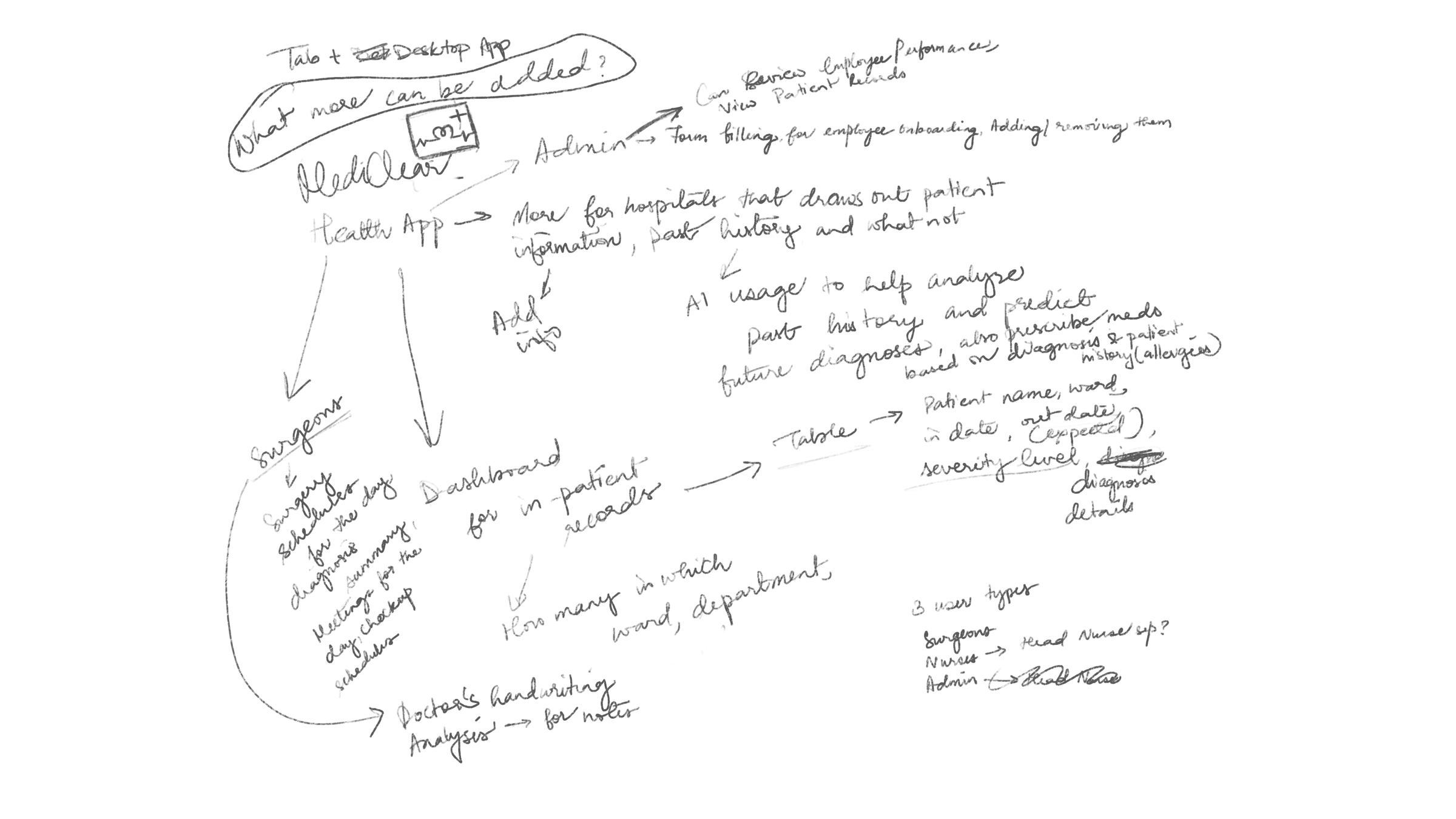
Discovery ran through direct conversations with clinic staff about how a day actually unfolds, from the morning surgery board to the evening billing reconciliation. Shadowing the workflow surfaced the constraints that no feature list would have: the discharge conversation happens while the family is distracted and upset, records move between branches in a car, and the person entering data is often the person also holding the animal. Benchmarking against existing veterinary software showed tools built for record-keeping compliance rather than for the rhythm of a shift.
Strategy
The organising insight was borrowed from the tool's origin as a human-hospital discharge product: the reader of the output is not the clinical subject. In veterinary care that becomes literally true. The patient is the animal; the client is the human who pays, is contacted, and reads the take-home summary. That distinction drove the entire information architecture. Body weight became a first-class field rather than a note, because veterinary dosing is weight-based and the AI needed it as context. Three role-calibrated surfaces were designed on one shared shell: a clinical command center, a business command center, and a document the family takes home.
Wireframes
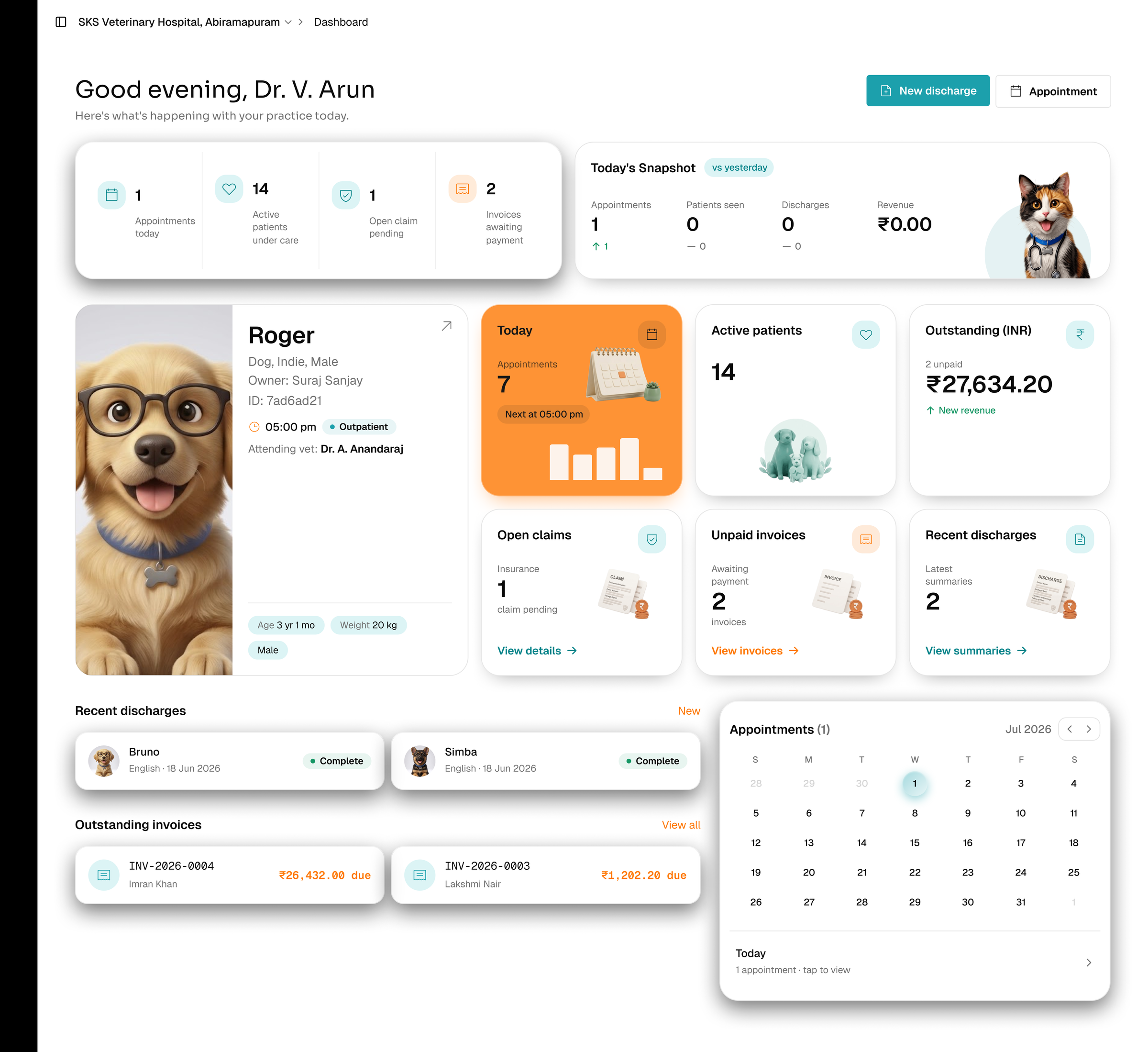
Layout explorations tested how much of the shift to surface at once. The clinician's dashboard was structured around resumption rather than reporting: today's appointments, the featured patient, what changed since yesterday. The financial surface was iterated separately to carry genuine density without reading as an analytics dashboard. The discharge output was designed as a document first and a screen second, because its final form is printed paper in a car park. A visual timeline of the hospital stay was prototyped early, since in mixed-literacy households it carries more weight than the prose does.
Iterations
The AI surfaces took the most iteration, and almost none of it was visual. The question was where to place human judgment. Early versions let the AI output flow straight to the export. That was wrong, and correcting it reshaped the flow: staff now review the plain-language version before anything is printed, as a real check rather than a formality. The patient-facing disclaimer moved from a footer to near the top of the document, in the same plain register as the rest of it, because the person most likely to need that line is the person least likely to read a footer. Its copy is fixed and reviewed in all six languages rather than generated fresh on each request, so the wording stays dependable.
What we built
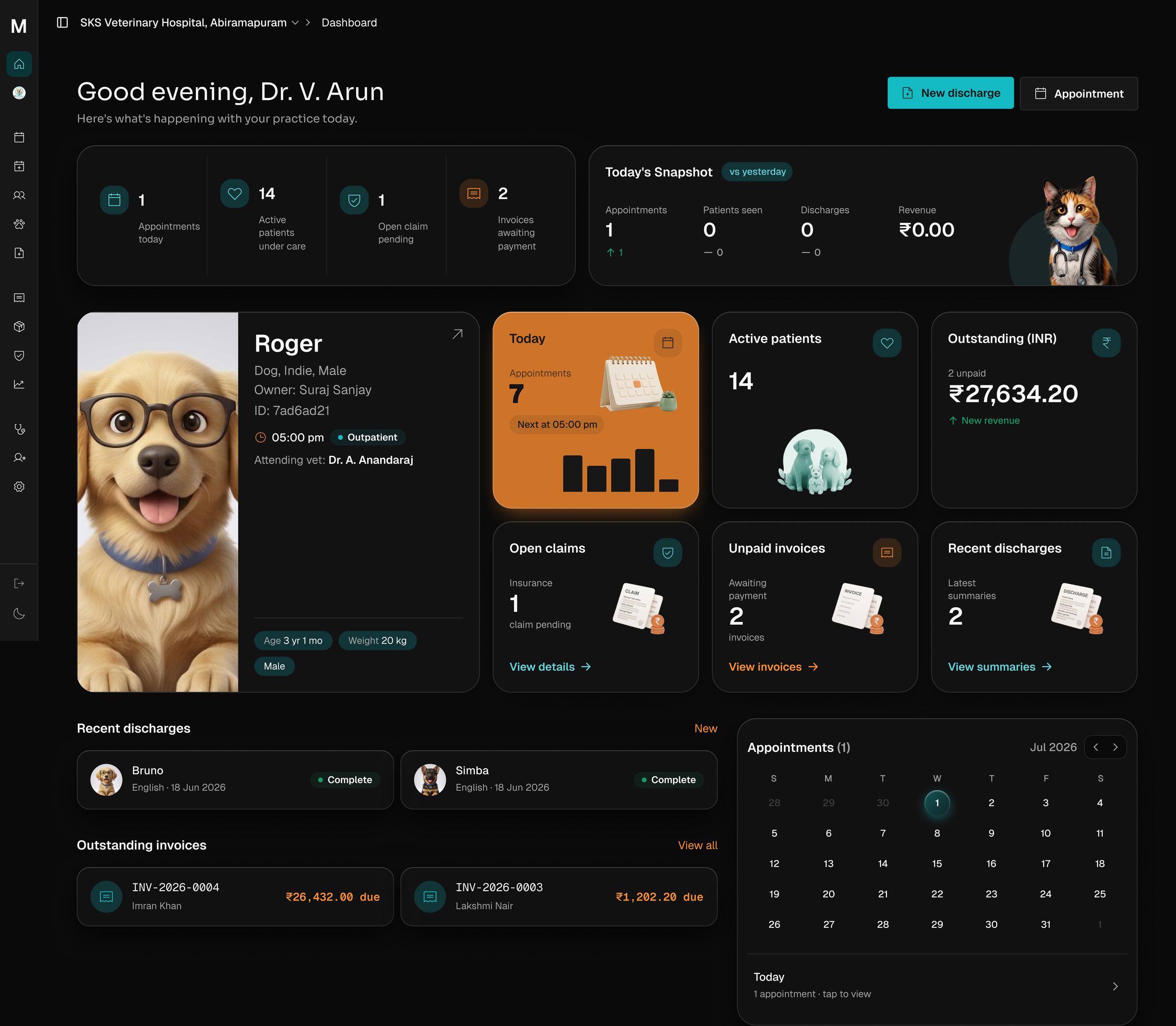
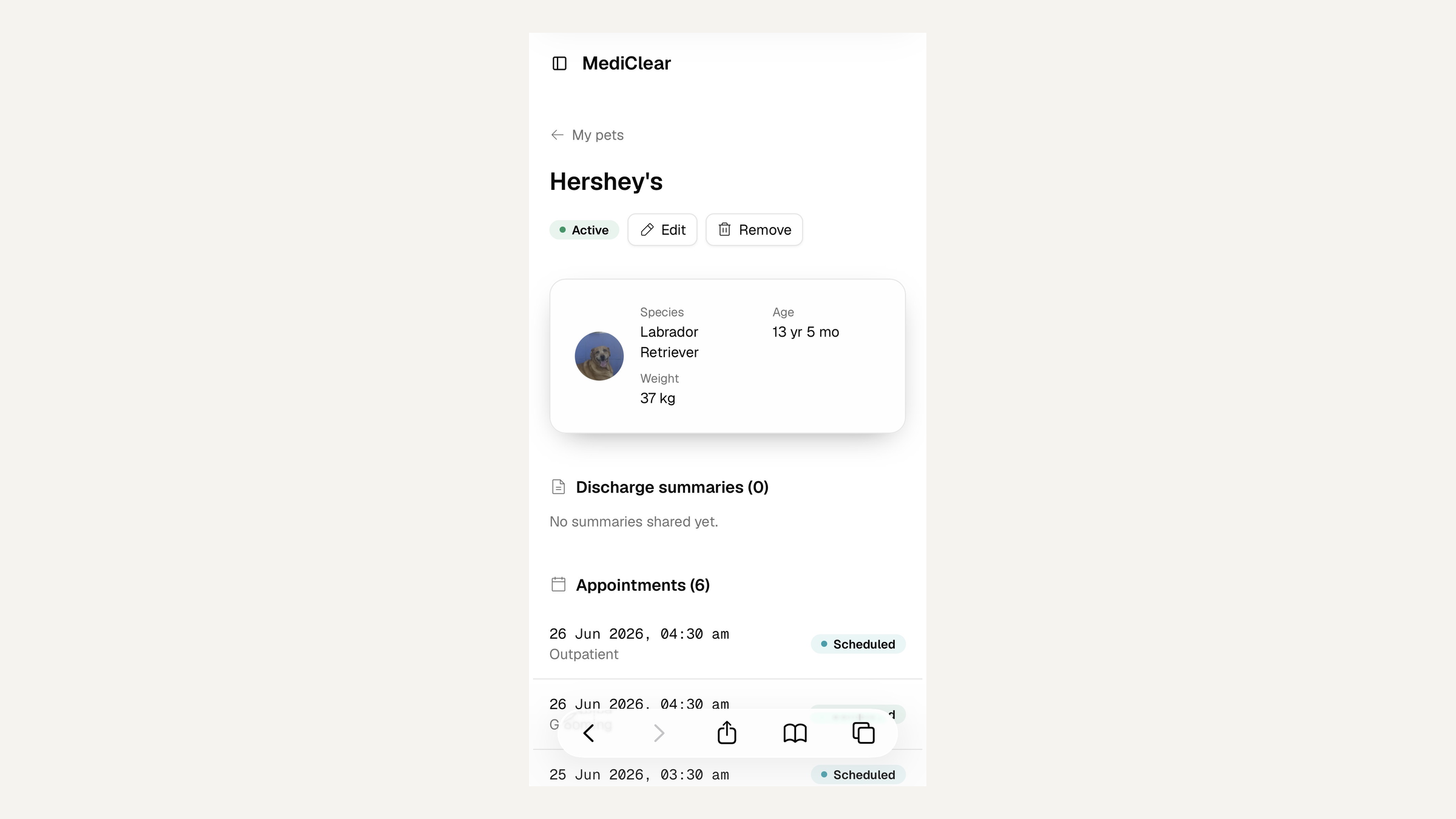
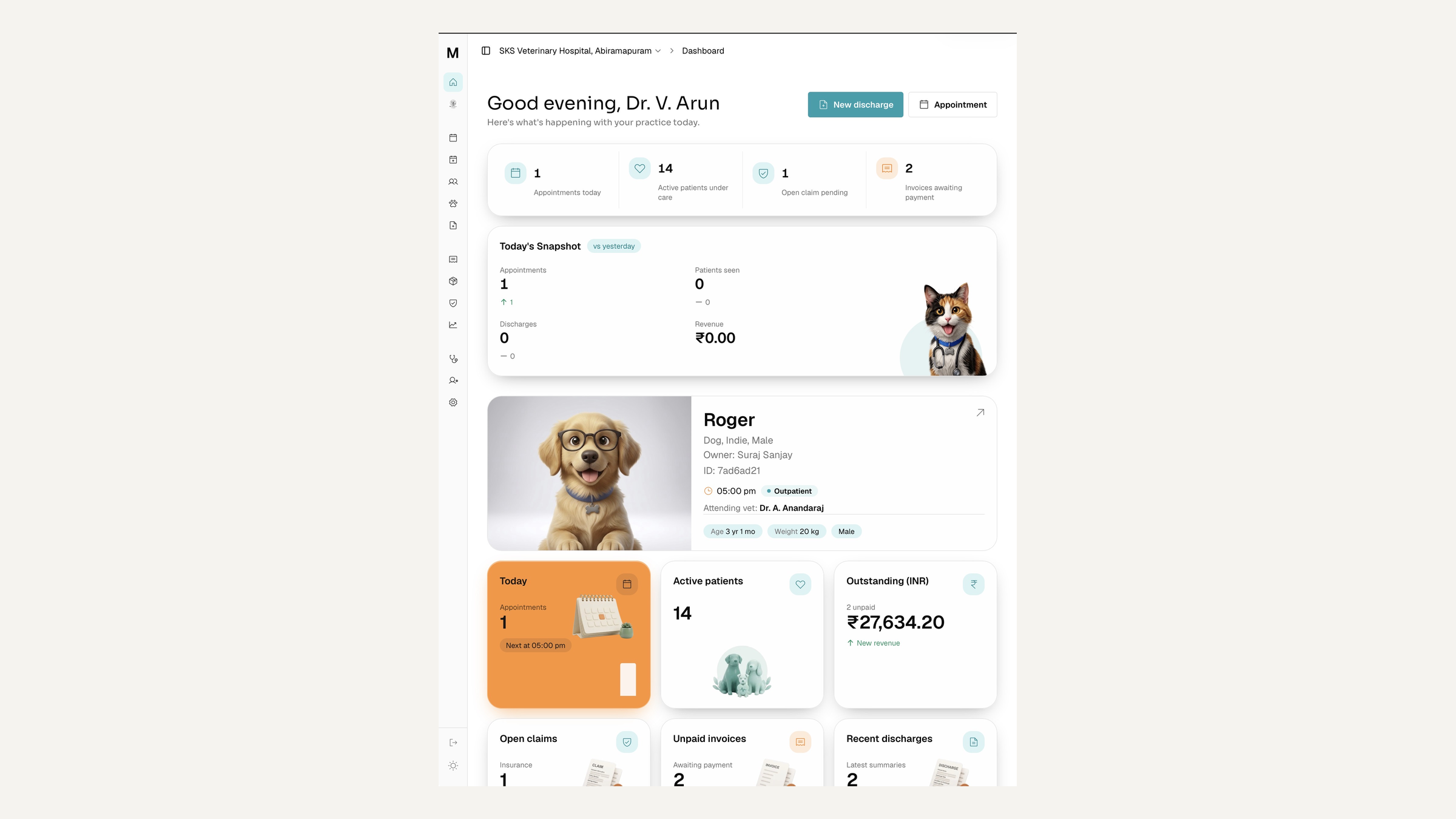
MediClear is a veterinary practice operating system with an AI discharge tool at its centre. Clients and their animals are first-class linked records. Around that sit appointments with a full status lifecycle, invoicing with recorded payments, inventory, pet-insurance claim tracking, a consolidated report timeline that gathers X-ray, ECHO, ultrasound, and outsourced lab files into one scrollable history, and a pet parent portal where a family can view their animal's records and request a booking. Each branch's data is isolated. Every surface is responsive from the ward workstation down to the phone in a technician's coat pocket.
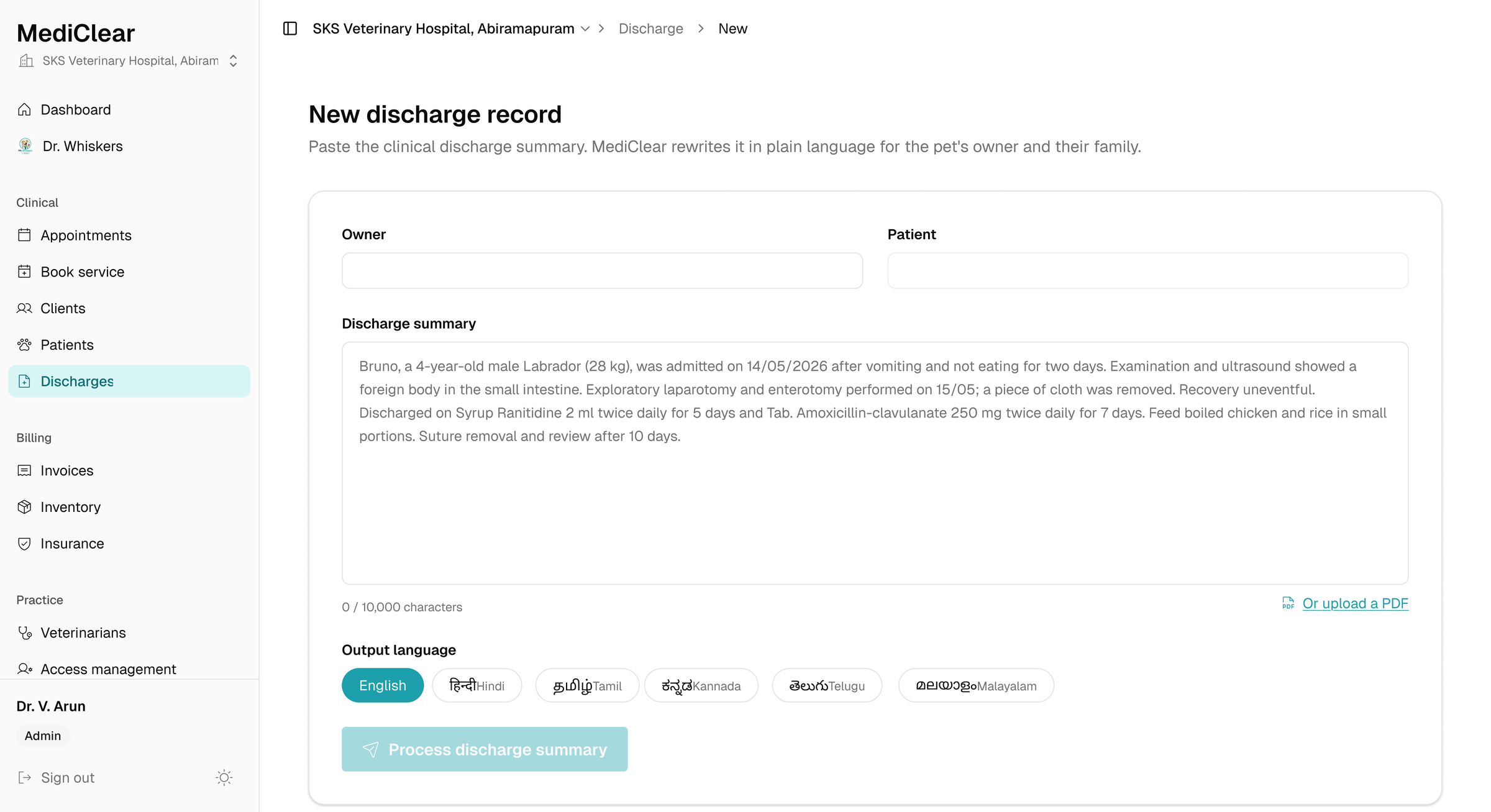
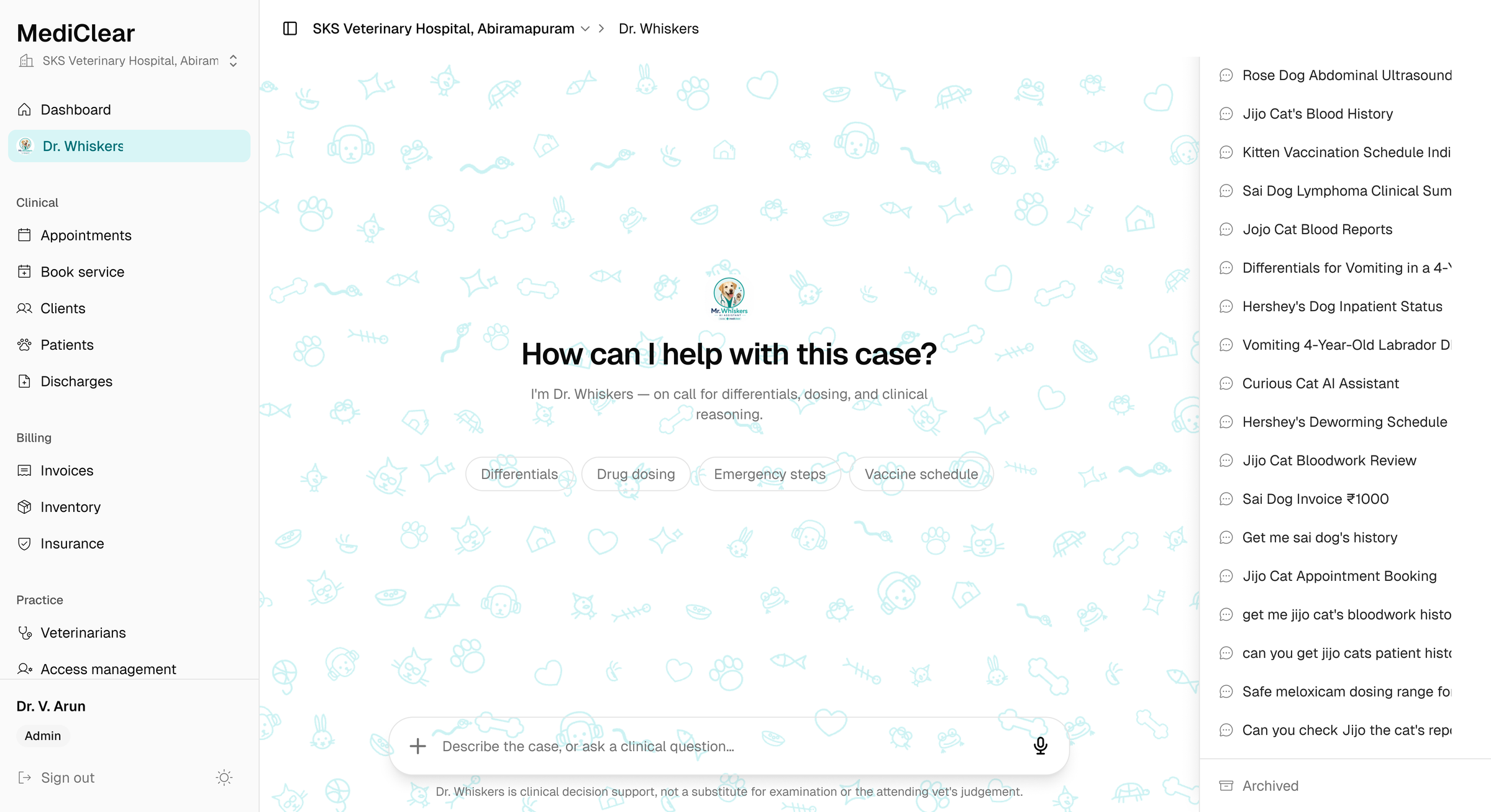
Three agents, each scoped narrowly. The discharge agent takes a clinician's notes and produces a plain-language explanation, a visual timeline of the stay, a medicine schedule, and warning signs, in English and five Indian regional languages, written for everyday spoken register rather than a formal one. A vision agent reads photographed prescriptions and uploaded patient histories, including the legacy formats clinics actually have. A vet assistant answers questions against the clinic's own records rather than against the open internet. The guardrails are the design: the AI is instructed never to introduce a medication, dosage, or date absent from the source; a staff member reviews every patient-facing output before export; and each document carries fixed, reviewed copy telling the reader that AI helped prepare it and to check with their care team if anything contradicts the doctor.
One language across every surface. A teal and warm-orange palette carried through light and dark modes, a serif display voice against a functional body face, and a component set that holds shape from a data-dense financial table to a single card on a phone. The system was built to survive the real failure mode of a fast-moving product: not ugliness, but drift, where twelve reasonable answers to the same question quietly become twelve different components.
What changed
Results
MediClear replaces the folder, the phone call, and the guesswork with a single record that follows an animal between branches and ends in a document a family can read. The discharge tool is the clearest measure of the shift: the same clinical information, previously delivered as an unreadable artefact of compliance, is now delivered as an act of care. Building it end to end, design through implementation, meant the hardest decisions were not visual ones but questions about where AI stops and human judgment begins.
Learnings
The design problem was never the interface. It was the tension between two users who want opposite things: staff need efficiency and structure, families need warmth and clarity, and both are served by the same record. Resolving that meant designing the output as a document rather than a screen, and treating the printed page as the real product surface. The second lesson was about where AI belongs in a clinical tool. The temptation is to let it do more; the discipline is deciding what it must never do unreviewed. Tenant isolation, dosage fidelity, and the patient-facing disclaimer were specified, implemented, and read line by line rather than left to inference. Designing with AI turned out to be mostly the work of drawing that boundary clearly and then holding it.
Next steps
Delivery over WhatsApp is the single highest-value addition, because that is where everyday communication in India already happens, and the report timeline currently stops at composing a message by hand. Beyond that: inline editing or a lighter 'flag this line' mechanism so staff can correct AI output without regenerating the whole document, a per-hospital default language with a per-record override, a live payment gateway, and a self-service owner portal with phone-based authentication.
Next project
The Name Was Already the Argument. Nothing in the Brand Was Using It.The Smarketers · B2B Marketing Agency · Brand & Website · 2026
See all works