Designing a Humane Content Moderation Queue
Redesigned the content moderation workflow to reduce moderator cognitive load, improve decision accuracy, and introduce wellbeing-aware interaction patterns, treating reviewer safety as a design requirement, not an afterthought.
The Gap
Business gap
Platforms rely on content moderation to maintain user safety and regulatory compliance, yet the internal tools moderators use are often afterthoughts: built for throughput, not for the humans operating them. Burnout and turnover among moderators are well documented in the research this project drew on (Sarah T. Roberts's work on commercial content moderation, platform transparency reports), and turnover erodes decision consistency directly, since a queue relearns policy nuance every time it loses a trained reviewer.
User gap
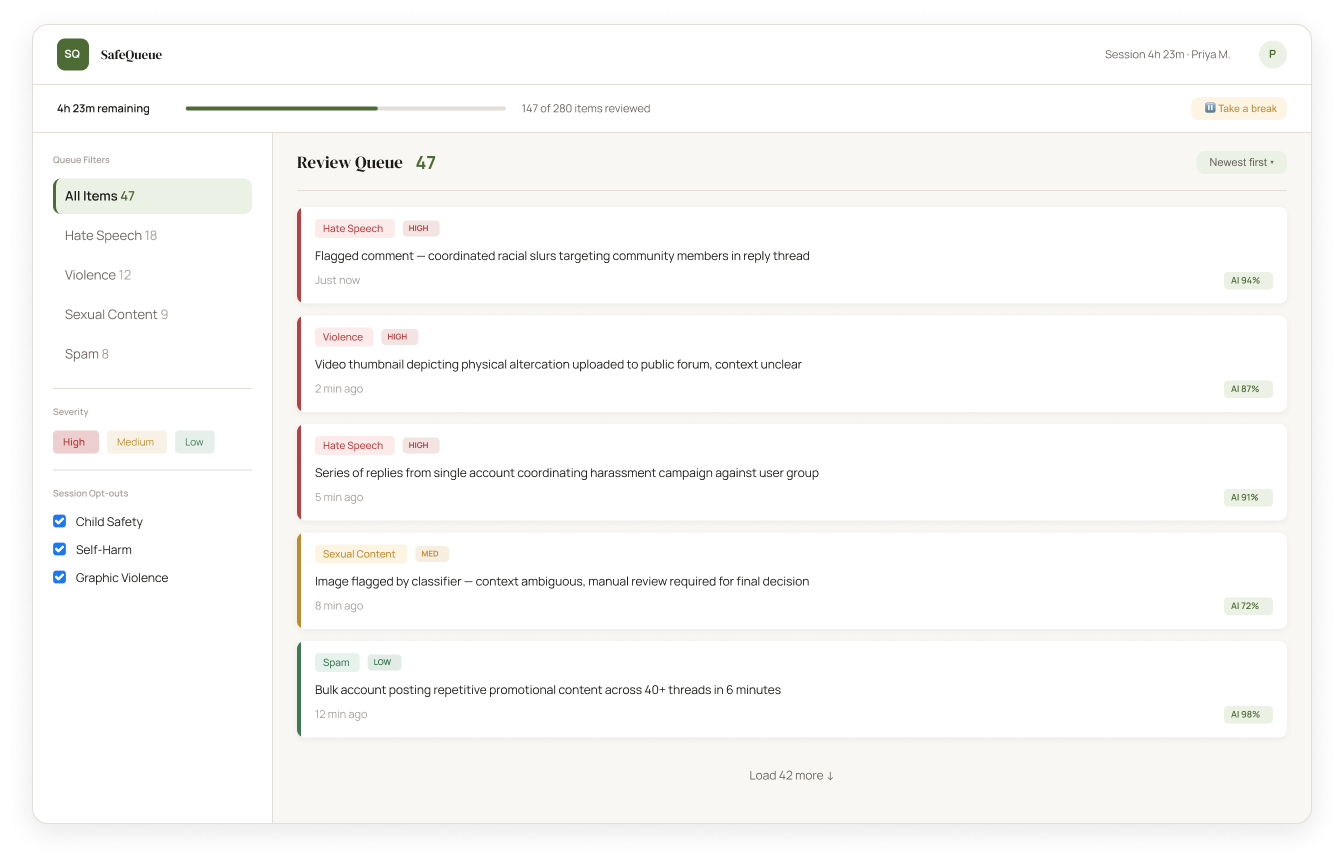
Content moderators review a continuous stream of flagged items each shift, including graphic, hateful, and disturbing content, using tools that offer little control over exposure intensity, minimal decision-support context, and no structured wellbeing checkpoints. The result is cognitive overload, emotional fatigue, and inconsistent policy application under pressure.
How I worked
Research
Conducted secondary research drawing from published studies on content moderation labor (including work by Sarah T. Roberts, platform transparency reports, and the Christchurch Call documentation). Analyzed publicly available descriptions of moderation tooling from platform transparency reports and journalistic investigations. Mapped common workflow patterns: queue ingestion, content review, policy matching, decision logging, and escalation.
Strategy
Defined a 'dignity for the reviewer' design principle: every interaction should protect the moderator's cognitive and emotional capacity while supporting accurate, consistent decisions. The strategy centered on three pillars: graduated exposure control, decision scaffolding, and embedded wellbeing patterns.
Wireframes
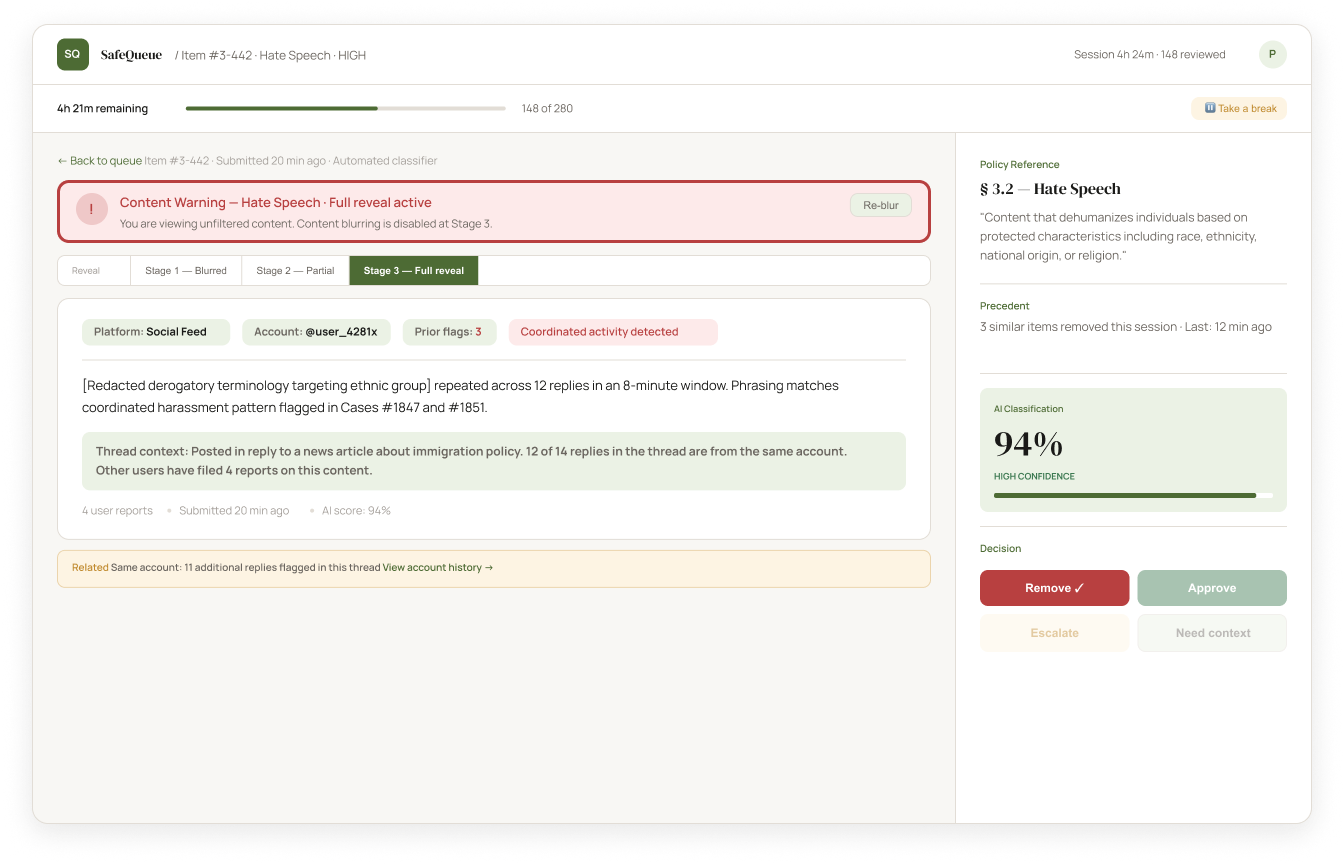
Explored three structural approaches: a linear queue model (one item at a time), a triage dashboard (multiple items with severity sorting), and a guided decision-flow model. The guided decision-flow was selected because it balances throughput needs with cognitive protection, presenting content in controlled stages with policy context surfaced alongside each item.
Iterations
Iterated on exposure control mechanisms: blur levels, content-type warnings, opt-out for specific content categories during a session. Refined the decision scaffolding to surface relevant policy excerpts alongside flagged content rather than requiring moderators to recall policies from memory. Added session-based wellbeing checkpoints (non-intrusive, moderator-controlled) informed by occupational health research on secondary trauma.
What we built
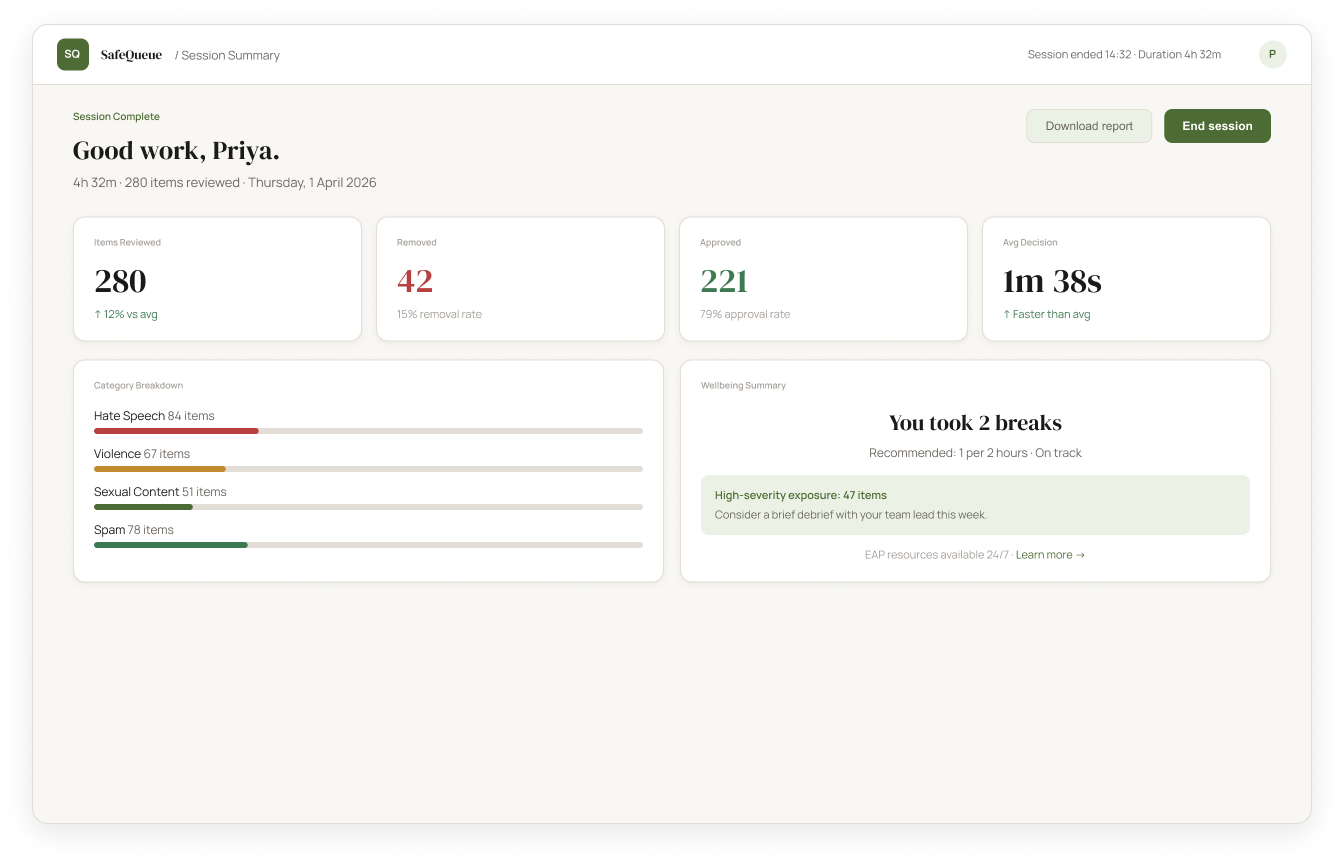
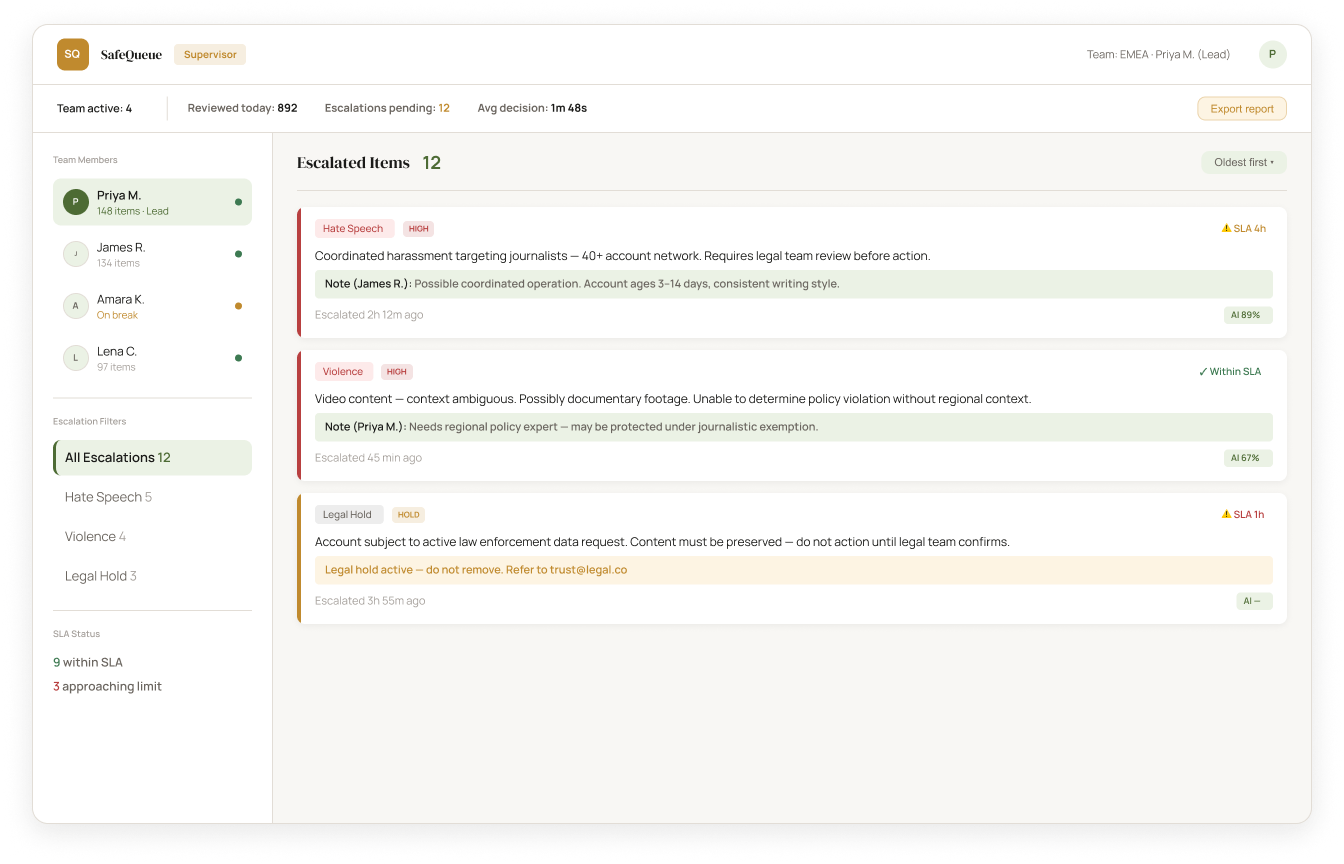
A moderation workspace designed around three layers: a graduated exposure system that lets reviewers control content visibility before full reveal, a decision scaffold that pairs each flagged item with relevant policy context and precedent examples, and session-aware wellbeing patterns including break prompts, shift progress indicators, and content-type rotation controls. The interface treats moderator capacity as a finite resource to be preserved, not just throughput to be maximized.
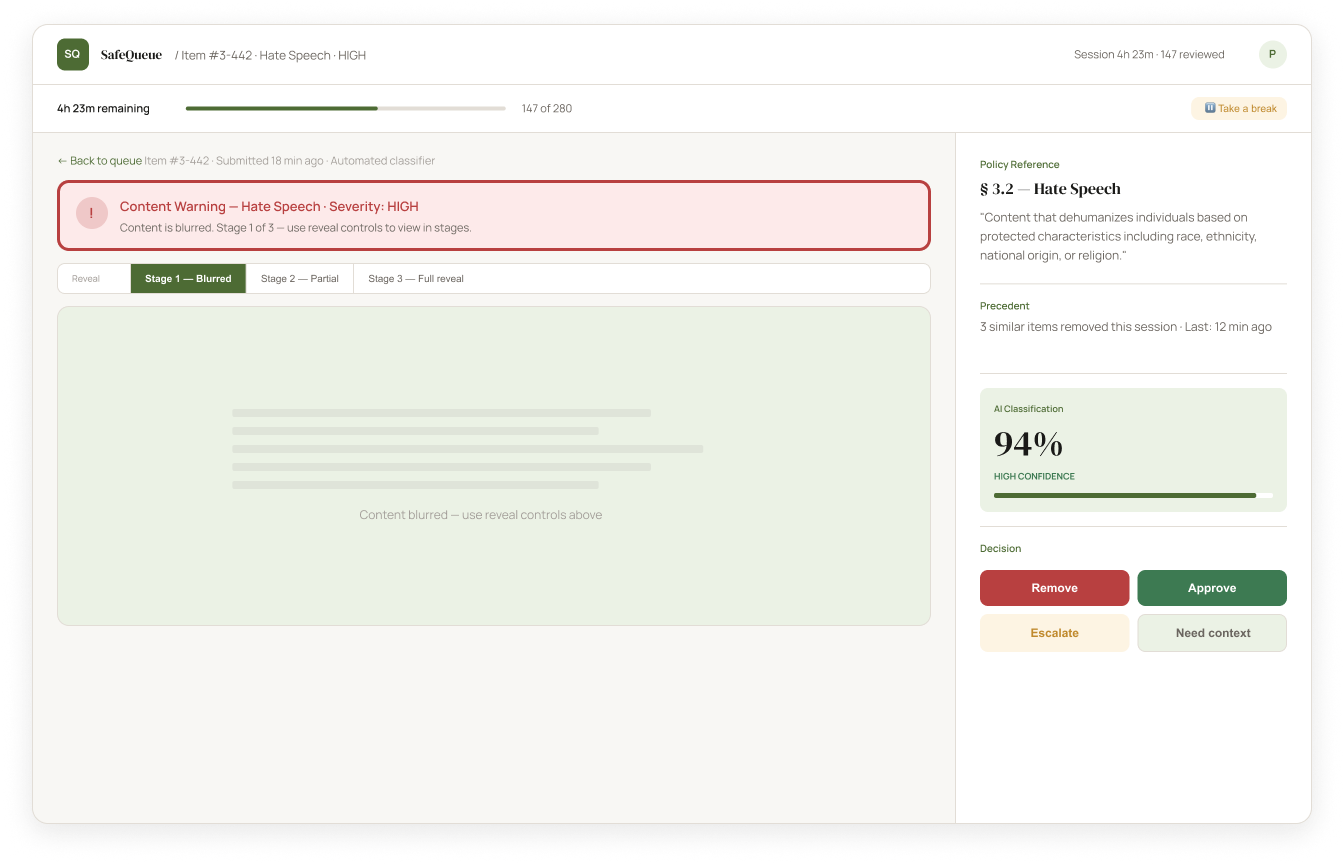
Integrated an AI pre-classification layer that categorizes flagged content by severity and policy area before it reaches human reviewers. This allows the queue to be organized by content type and intensity, enabling moderators to opt out of specific categories during a session and supporting graduated exposure. AI confidence scores are surfaced transparently so reviewers understand when they are confirming a high-confidence classification versus making a judgment call on ambiguous content.
Designed reusable patterns for sensitive content display (blur states, reveal controls, content warnings), decision-support cards (policy excerpt, precedent example, confidence indicator), and session management components (wellbeing check-in, shift timer, content rotation controls). These patterns could extend to any internal tooling where operators handle sensitive or high-volume decision workflows.

What changed
Results
As a conceptual project, the focus was on redefining how moderation tools relate to the humans who use them. Thoughtful exposure controls and decision scaffolding improved both reviewer safety and decision consistency at the same time, the clearest demonstration that treating wellbeing as a design requirement doesn't cost the platform anything on the accuracy side.
Learnings
Designing for high-volume decision workflows requires treating human cognitive limits as hard constraints, not soft preferences. Exposure control is not a nice-to-have; it is a safety requirement. The most impactful design decisions were often the simplest: surfacing policy context at the point of decision instead of expecting recall, and making break prompts visible without making them punitive.
Next steps
Future iterations would explore adaptive queue pacing based on content severity exposure over a session, team-level analytics for identifying burnout risk patterns, cross-platform policy consistency tooling, and structured feedback loops where moderator decisions inform AI classification improvements over time.
Next project
Every Grocery App Sells You Items. None of Them Sell You Dinner.GrocEasy · Grocery & Recipe Delivery · Concept · 2026
See all works